Geological Setting of Desert Rose Mine
The Desert Rose Mine, formerly known as the Rock Eagle Mine, is located in the Silurian Hills, San Bernardino County, California, 15 miles southeast of Death Valley. Situated within the tectonically complex Walker Lane and Eastern California Shear Zone (ECSZ), the mine targets silver mineralization in the Riggs formation, with potential gold prospects in the underlying Pahrump group, as illustrated in the geological map below.
Riggs Formation: Host to Silver Mineralization
- Carbonate Host Rock: The Riggs formation, a Paleozoic(?) carbonate sequence, forms the thrust plate above the Riggs thrust, overlying the Pahrump group. It hosts primary silver in galena, localized at intersections of small cross faults.
- Mineralization Characteristics: Silver is associated with dark-brown, hydrothermal manganiferous dolomite and barite, with spotty and irregular distribution. Secondary oxide ores likely contributed to historical production, estimated at $200,000 from the Riggs (Alta) silver mine (ca. 1913–1920).
- Structural Controls: The Riggs thrust and associated chaos structure, involving imbricate faulting, create favorable conditions for mineralization by facilitating fluid pathways along fault zones.
Pahrump Group: Potential for Gold
- Clastic Sequence: The Pahrump group, an 11,000-foot-thick late Precambrian sequence, consists of coarse clastic rocks (quartzite, conglomerate, dolomite) intruded by granitic rocks. It forms the footwall of the Riggs thrust.
- Gold Prospects: Gold is reported in prospects associated with copper in the Pahrump group, particularly near Silurian Peak, suggesting potential for polymetallic deposits in the Desert Rose Mine area.
- Facies and Source: Dominated by orthoquartzite and dolomite, the Pahrump group reflects a southerly sediment source, with facies changes indicating marine deposition and possible alluvial fan deposits (e.g., member 18 fanglomerate).
Structural and Tectonic Context
- Riggs Thrust and Chaos: The mine lies within a chaos structure, where Pahrump group fragments were displaced southwestward up to 2 miles, piled in an imbricate structure. The Riggs thrust, with a minimum 8-mile displacement, localizes mineralization.
- Garlock Fault Influence: The east end of the Garlock Fault, a major strike-slip feature, enhances mineralization in the ECSZ by creating fault-controlled conduits for hydrothermal fluids, potentially influencing the Desert Rose Mine’s deposit formation.
- Block Faulting: North-trending high-angle faults and post-thrust warping shape the Silurian Hills’ topography, affecting mineral exposure and accessibility.
Geological Map
The following map by Donald H. Kupfer (1960) illustrates the geological setting of the Silurian Hills and fault structures that influence mineralization at the Desert Rose Mine.
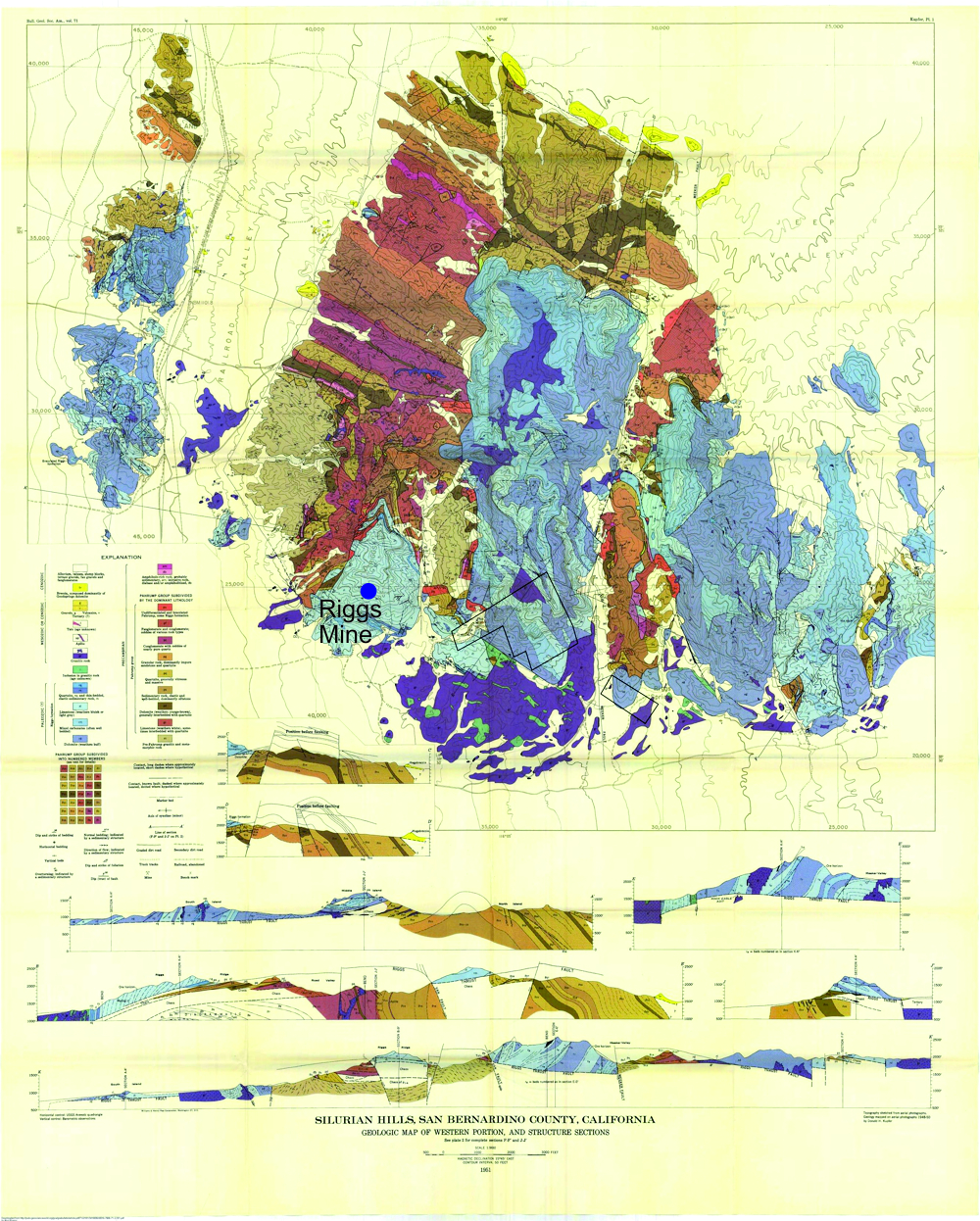
Geologic Map of the Silurian Hills, San Bernardino County, California (Kupfer, 1960). Source: Bulletin of the Geological Society of America, Vol. 71.
The Desert Rose Mine’s geology, characterized by silver-rich carbonate rocks of the Riggs formation and potential gold in the Pahrump group, is enhanced by the Silurian Hills’ complex tectonic setting, making it a key target for exploration in the Walker Lane and ECSZ.